


Watson Bio Lab
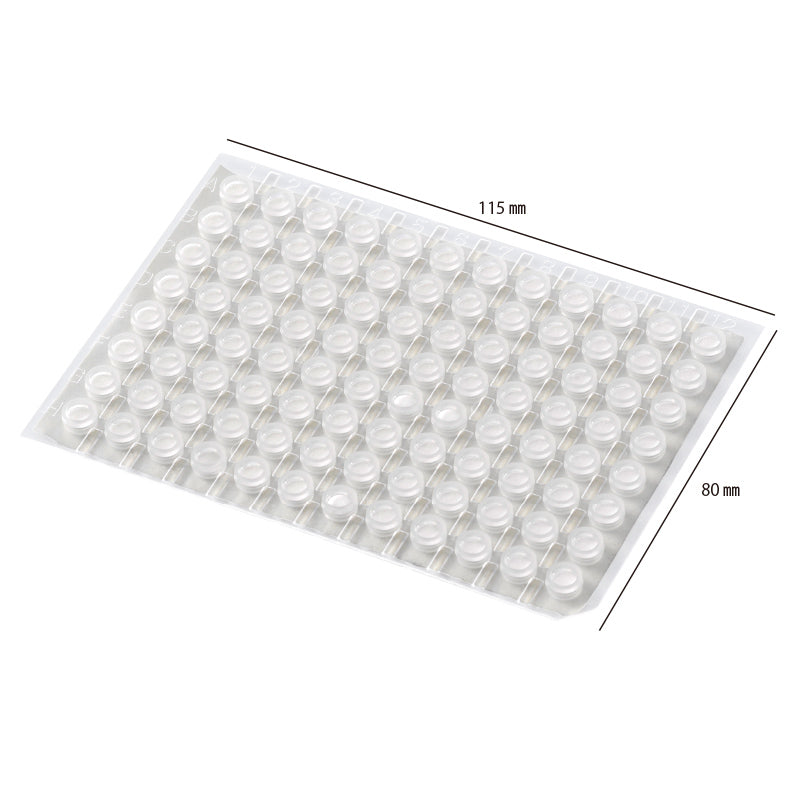
Preservation Plate, 96-well, Nylon "176-502C" (5 pieces)
Preservation Plate, 96-well, Nylon "176-502C" (5 pieces)
Volume:96 well
Unit:5 pieces / unit
Couldn't load pickup availability
■Payment Methods Accepted:Credit Card / PayPal / Google Pay / Amazon Pay
■Delivery Fee:Free shipping fee in the U.S. - no minimum required
Contact Us View full details
About
Material: Polypropylene
Samples such as DNA can be preserved in a dry state. A new style of sample preservation.
- Space Saving
- Easy to transport and distribute
- Reduce Contamination Risk
- Recover Samples Directly on PCR Plate
Watson's Preservation Plate (Nylon type) has been developed in order to enable storage and transportation of such bioresources as nucleic acids such as DNA, RNA and oligonucleotides under room temperature and pressure.
Simply place such samples onto paper chips, then dry, the preservation is completed.

Using PVP the samples remain in the same condition for every ISH providing you have preserved samples in a suitable amount for each experiment.
The preservation period is more than 4 months under normal temperature.

■Preservation of Samples

①Check a protection seal and a plate in the package.
*Top side is where you can see paper chips.

②Get your sample absorbed into paper chips.
5uL can be pipetted at a time.
For bigger sample volume, divide it into several times and repeat pipetting and drying.
③Dry in room temperature.
Dry the sample for at least 1 hour. Reduced pressure drying is recommended. Keep it under 50℃ when heat drying in order to prevent devices from deteriorating. Make sure a sample to be preserved has resistance to the heat.
*Insufficient drying may result in faulty performance.

④Seal the plate with the protection seal.
*Make sure that the film is tightly applied. Loose sealing may cause contamination.
⑤How to preserve
Avoid high temperature, high humidity, strong lights for preservation. It is recommended to store the plate in a cool dark place with desiccants. High purity nucleic acid not contaminated by resolving enzyme etc. can be stored under room temperature. Freezing is not recommended because of such risks as contamination off sample by dew condensation, or deterioration of sample by freezing and melting. Do not store under temperature less than -40 ℃ as it may deteriorate and damage devices. Conduct half-life test as preservation time varies depending on sample's type, purity and environment.
■Extraction of Samples

To peel only select lines, it is easier if you cut the seal in advance using a knife or scissors.

②Drop a sample into tube etc.
【In case of tube】
Elute by adding eluent and mixing. In case of nucleotide, approx. 90% can be eluted in 3 minutes. Paper chips can be directly put into a container, without the step to elute a sample if it is used as primer or probe.

【In case of PCR plate】
Push the paper chips into wells by tweezers etc.
★The plate has a well layout that matches the standardized well position of existing 96 well plates in your lab. Simply place the plate on your 96 well plate and push the paper chip into it.

Let customers speak for us
Shopping experience was great! However, the tips are not fitting my Opentrons robot - these are too loose for it and cannot be attached reliably.
Great quality, correct quantity, and the case is sturdy. Zero complaints!

I recently received the WATSON BIO LAB 124P Long Filtered Tips, and these are exactly what you'd expect from high quality lab consumables. For my purposes, I use them as props in medical and science flat lays, and they look incredibly real—because they are real.✨ The quality of these tips is evident. Made from good plastics, they maintain their form and appearance, crucial for detailed photography. The natural color is consistent, and the filtering mechanism is clearly visible, adding to their authenticity. The polypropylene rack keeps them organized and easily accessible, a small but valuable detail.✨ While my use case is for visual media, the inherent quality suggests they would perform well in their intended scientific applications. They are robust enough to handle repeated handling for prop setups without deforming or showing wear. These are a solid choice for realistic props.Tips & Alt Uses💡 Authentic Props: Ideal for creating realistic medical or scientific themed flat lays and visual content.As an exclusive contributor to a prominent stock media agency with 25 years of experience in freelance photography and videography, I offer informed and professional opinions of camera and video equipmentI will update this review if anything changes within 1 year. A 5 star rating indicates the product meets my expectations for its purpose.

I recently received the WATSON BIO LAB 124P Long Filtered Tips, and these are exactly what you'd expect from high quality lab consumables. For my purposes, I use them as props in medical and science flat lays, and they look incredibly real—because they are real.✨ The quality of these tips is evident. Made from good plastics, they maintain their form and appearance, crucial for detailed photography. The natural color is consistent, and the filtering mechanism is clearly visible, adding to their authenticity. The polypropylene rack keeps them organized and easily accessible, a small but valuable detail.✨ While my use case is for visual media, the inherent quality suggests they would perform well in their intended scientific applications. They are robust enough to handle repeated handling for prop setups without deforming or showing wear. These are a solid choice for realistic props.Tips & Alt Uses💡 Authentic Props: Ideal for creating realistic medical or scientific themed flat lays and visual content.As an exclusive contributor to a prominent stock media agency with 25 years of experience in freelance photography and videography, I offer informed and professional opinions of camera and video equipmentI will update this review if anything changes within 1 year. A 5 star rating indicates the product meets my expectations for its purpose.

Perfect fit and function with my 100µL micropipette. The extra-fine tips are great for precision work and help ensure that all fluid comes out properly. Built-in filters offer peace of mind against operator errors and when dealing with sensitive samples. The 96-tip tray arrived well sealed and ready to use. The rack has a lift-off lid (not hinged), which is fine for our workstation setup. All in all, high quality tips, no issues to report.

The media could not be loaded.
These micropipette tips work really well. The box comes pre-wrapped. These fit easily on my 200 microliter pipettes, in addition to my 100 microliter pipettes. The video shows them on my 200 microliter.
Perfect fit and function with my 100µL micropipette. The extra-fine tips are great for precision work and help ensure that all fluid comes out properly. Built-in filters offer peace of mind against operator errors and when dealing with sensitive samples. The 96-tip tray arrived well sealed and ready to use. The rack has a lift-off lid (not hinged), which is fine for our workstation setup. All in all, high quality tips, no issues to report.

The media could not be loaded.
These micropipette tips work really well. The box comes pre-wrapped. These fit easily on my 200 microliter pipettes, in addition to my 100 microliter pipettes. The video shows them on my 200 microliter.
Good quality tips that fit my pipette perfectly. No leaks, and they come neatly packed. Great for lab use.

Dangit, I opened it wrong and the spilled out, so be careful. This set of filtered tips is great! They have a hydrophobic design to prevent over aspiration and fit almost any pipette for uour lab work. Made in Japan and very high quality!
Very quality filtered tips. Super pointy, the filter is suitably high up. Comes nice packed. Do not use for PCR or any DNA type use so cannot speak to contamination, but should be free. Nice box, good amount of tips. The filter seems to do its job well, stops you accidentally aspirating your liquid into the pipette. Standard size, compatible.
I picked up this 96-piece set of 200 µL filtered tips for feeding and dosing my sick baby chicks, and I’m genuinely pleased with how well they work outside the lab. The hydrophobic filter keeps any backflow of fluids from contaminating the pipette barrel, which gives me confidence I’m delivering each dose cleanly.The tips seat snugly on my manual pipettor (I’m using it as a makeshift syringe), so there’s no wobble or leakage even at very small volumes. The natural-color plastic lets me see the liquid line clearly, making it easy to withdraw and dispense precise amounts of electrolyte solution or medicine. Ejecting spent tips is smooth—no stubborn catches or splatters.
These are excellent filtered tips, especially for the price. These are Made in Japan.I like the sterility guarantee to be free of DNA, good if you are conducting these types of studies.
These are excellent filtered tips, especially for the price. These are Made in Japan.I like the sterility guarantee to be free of DNA, good if you are conducting these types of studies.

Good quality tips that fit my pipette perfectly. No leaks, and they come neatly packed. Great for lab use.